
Observability
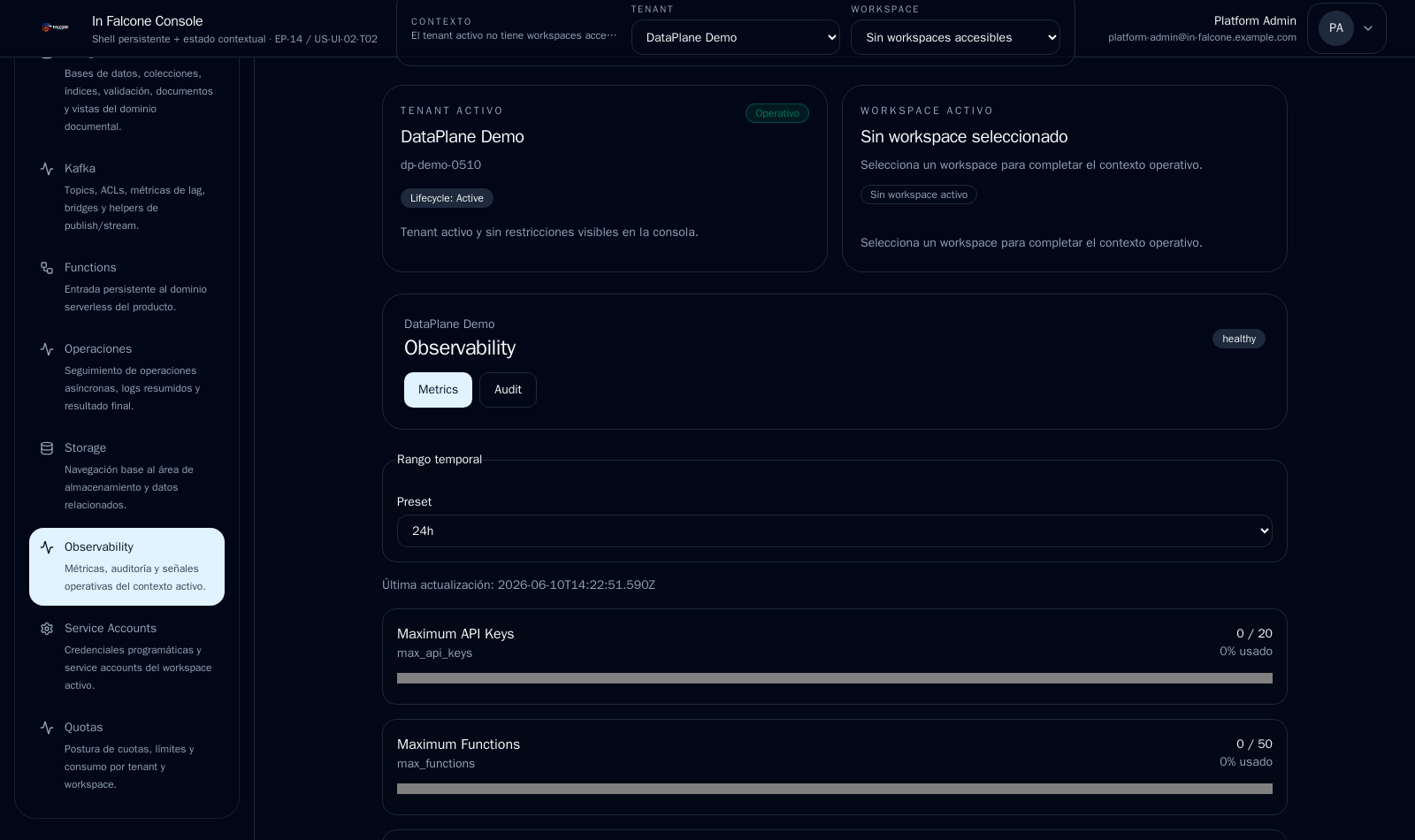
In Falcone ships a Prometheus-based observability stack (chart alias observability) and surfaces per-tenant signals in the console's Observability and Operations views.
What's collected
| Signal | Purpose |
|---|---|
| Platform metrics | Service health, request rates, latencies |
| Usage / consumption | Per-tenant resource usage (drives quotas & billing inputs) |
| Quota / limit signals | Threshold alerts, hard-limit enforcement decisions |
| Audit pipeline | Query-safe audit records for governed actions (e.g. function lifecycle) |
| Business metrics | Higher-level platform KPIs |
The repository enforces the schema and presence of these via npm run validate:observability-* checks (metrics stack, dashboards, health checks, business metrics, usage/consumption, quota policies, threshold alerts, hard-limit enforcement, console alerts, audit pipeline/event-schema/query/export/correlation surfaces).
HTTP request metrics
Both control-plane services expose falcone_http_requests_total (counter) and falcone_http_request_duration_seconds (histogram) at /metrics. The route label is the matched server-side template, including on responses rejected before authentication. Templates remain stable across restarts, so the Grafana p95 latency panel can continue to group by route. Resource names, keys, request queries and credentials are excluded from these labels.
The fixed route sentinels are unmatched for a missing route, proxied for executor fall-through to the control-plane, health for health/readiness endpoints, root for /, and overflow for registry saturation. Methods are restricted to GET, HEAD, POST, PUT, PATCH, DELETE, OPTIONS and OTHER; custom methods use OTHER.
Each HTTP registry Map has a hard cap of 16,384 distinct keys, with one slot reserved for a global overflow series. This accommodates about 191 templates × 8 methods × 10 statuses. Further new keys aggregate under method="OTHER",route="overflow" (counter status 0); existing keys continue counting. Overflow preserves counts and latency observations while discarding their individual route/method/status attribution. HTTP metrics have no tenant label.
The template labels replace the previous path-derived labels; historical series remain in the TSDB until retention removes them. Scrape sample and label-length limits are configured in the separate deployment chart repository.
Per-tenant visibility
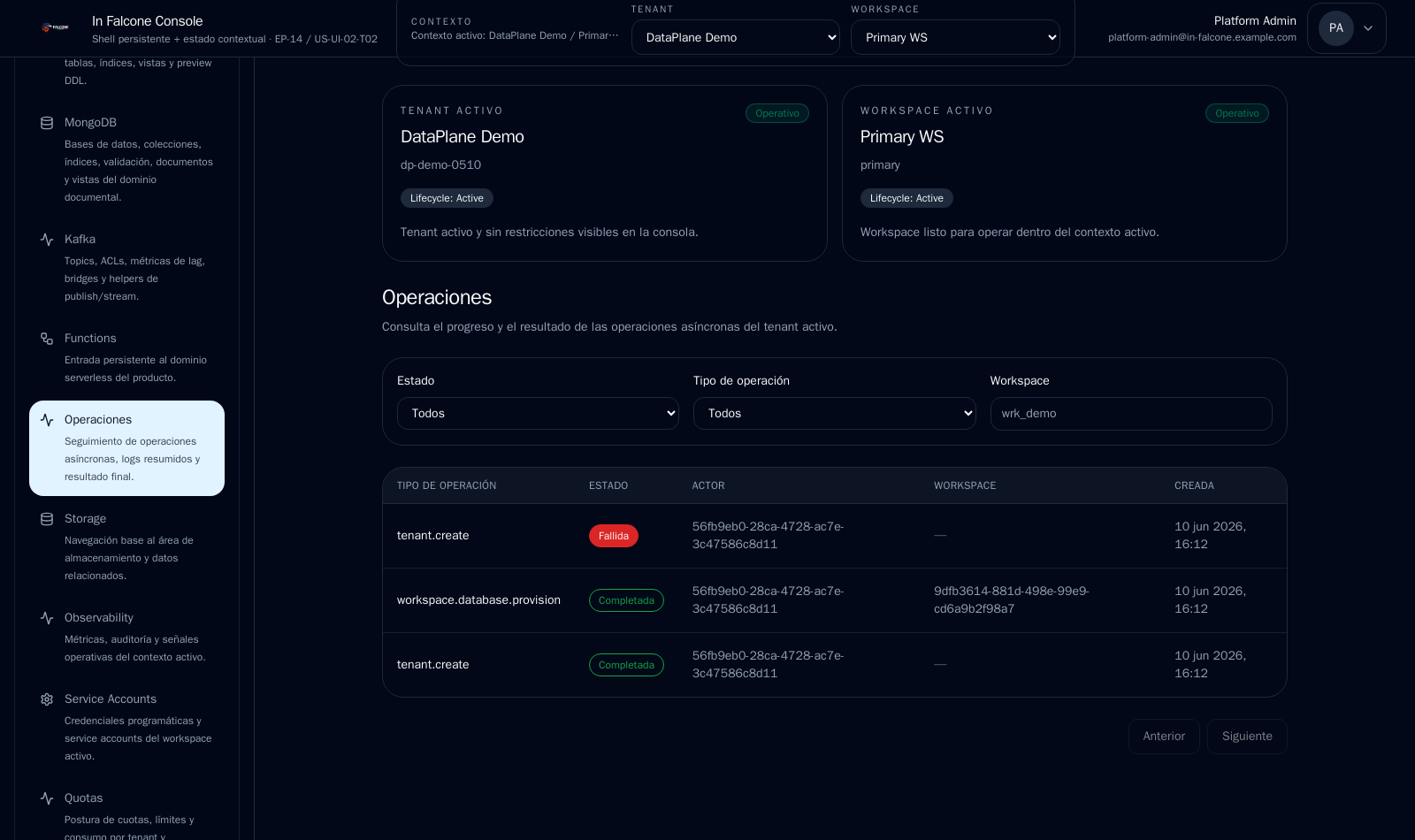
Metrics, usage and audit are tenant-keyed, so the console can show one tenant's consumption and operations without exposing another's. Operations records (with detail views) track governed actions and their outcomes.
Quotas & hard limits
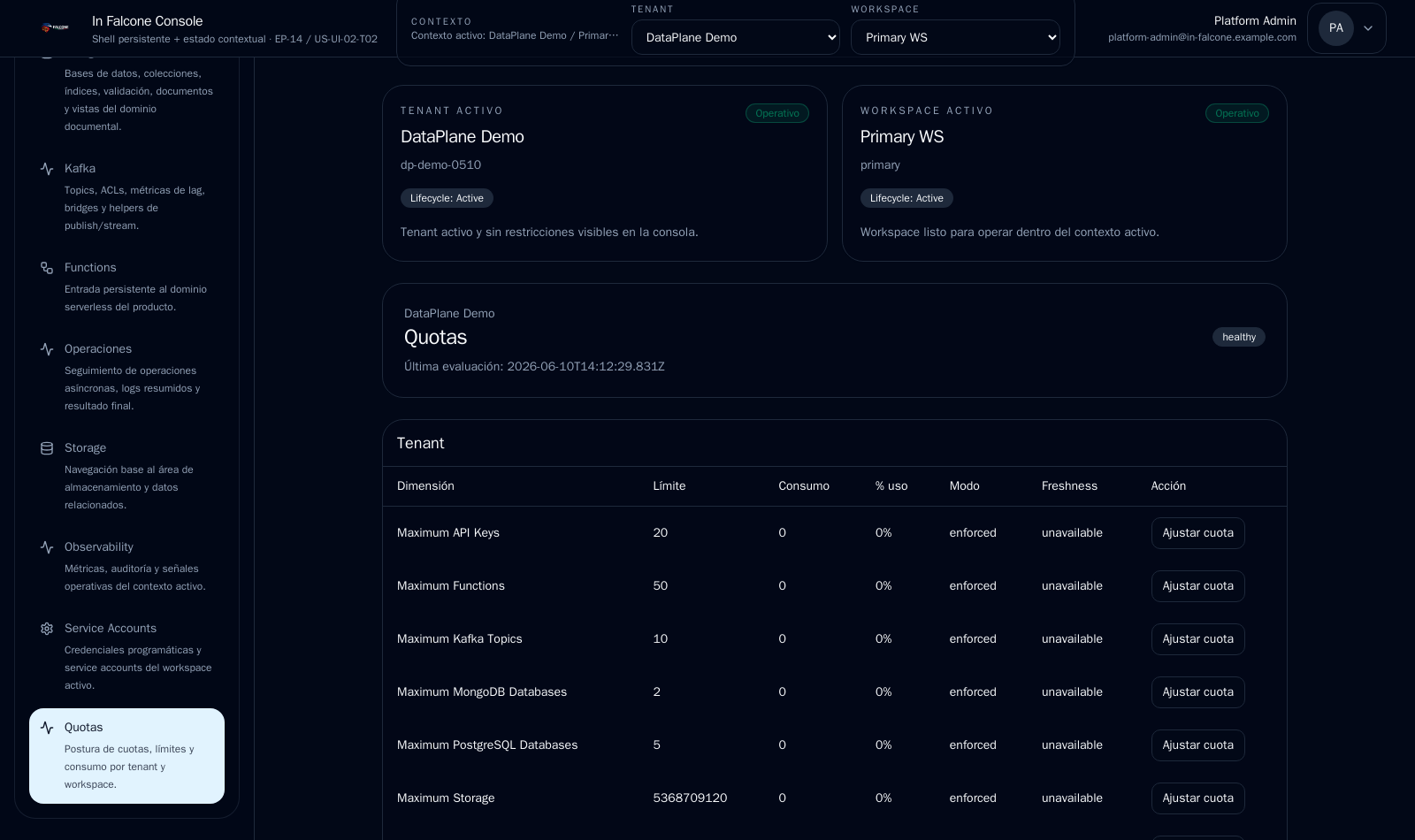
A plan's quota_policy defines enforced limits and overage behaviour (Domain Model). The observability stack raises threshold alerts as usage approaches a limit and records hard-limit enforcement decisions when a limit is hit — both visible in the console's Quotas view.
Health checks
Each component exposes health/readiness endpoints; helm upgrade --install gates on rollout completion. After install:
kubectl -n falcone rollout status deploy --timeout=300s
kubectl -n falcone get pods
Audit
Governed operations (function deployments, admin actions, rollbacks, quota enforcement) produce query-safe audit records (domain-model.json), retained for compliance and surfaced through the audit query/export/correlation surfaces.
The webhook signing master-key lifecycle does not add a public audit API or console view. Its operator CLI reports only opaque Secret-reference identities, custody modes, state, counts, timestamps, recovery deadline, request/rotation IDs, and sanitized codes. P4/P10 evidence must not include raw Secret/workload objects, Helm values/history, pod environment, ciphertext, or key bytes. Use Webhook Signing Master-Key Lifecycle: Collect audit and support evidence.
Flows & MCP signals (Preview)
The AI-native capabilities are first-class in the same stack:
- Flows — Temporal execution health plus the flow lifecycle audit topic (
FLOW_AUDIT_TOPIC); per-tenant flow quotas are enforced through the same quota machinery. - MCP —
mcpis a first-class audit subsystem (per-OAuth-client governance events), tenant-scoped and queryable in the console; per-tool-call usage rides thein_falcone_mcp_tool_invocations_totalmetric (business domainmcp_tool_usage) with latency on the normalized component-latency family, and themcp_tool_invocationsquota dimension surfaces in the per-tenant quota posture. All of these are covered by thevalidate:observability-*checks above. See MCP Architecture.